macOS Catalina introduces Voice Control, a new way to fully control your Mac entirely with your voice. Voice Control uses the Siri speech-recognition engine to improve on the Enhanced Dictation feature available in earlier versions of macOS.1
How to turn on Voice Control
After upgrading to macOS Catalina, follow these steps to turn on Voice Control:
On your Mac, choose Apple menu System Preferences, click Keyboard, then click Dictation. Open the Dictation pane for me. If a prompt appears, click Enable Dictation. If you’re asked if you want to improve Siri and Dictation, do one of the following. Modern free dictation software for Mac gives you incredible quality, and it’s already there on your computer. You will need some help with editing the text, though, so read on. Apple Dictation. Apple Dictation is native free dictation software for Mac and iOS devices, operating under Apple’s broader Voice Control functionality.
- Choose Apple menu > System Preferences, then click Accessibility.
- Click Voice Control in the sidebar.
- Select Enable Voice Control. When you turn on Voice Control for the first time, your Mac completes a one-time download from Apple.2
Voice Control preferences
When Voice Control is enabled, you see an onscreen microphone representing the mic selected in Voice Control preferences.
To pause Voice Control and stop it from from listening, say ”Go to sleep” or click Sleep. To resume Voice Control, say or click ”Wake up.”
How to use Voice Control
Get to know Voice Control by reviewing the list of voice commands available to you: Say “Show commands” or ”Show me what I can say.” The list varies based on context, and you may discover variations not listed. To make it easier to know whether Voice Control heard your phrase as a command, you can select ”Play sound when command is recognized” in Voice Control preferences.
Basic navigation
Voice Control recognizes the names of many apps, labels, controls, and other onscreen items, so you can navigate by combining those names with certain commands. Here are some examples:
- Open Pages: ”Open Pages.” Then create a new document: ”Click New Document.” Then choose one of the letter templates: 'Click Letter. Click Classic Letter.” Then save your document: ”Save document.”
- Start a new message in Mail: ”Click New Message.” Then address it: ”John Appleseed.”
- Turn on Dark Mode: ”Open System Preferences. Click General. Click Dark.” Then quit System Preferences: ”Quit System Preferences” or ”Close window.”
- Restart your Mac: ”Click Apple menu. Click Restart” (or use the number overlay and say ”Click 8”).
You can also create your own voice commands.
Number overlays
Use number overlays to quickly interact with parts of the screen that Voice Control recognizes as clickable, such as menus, checkboxes, and buttons. To turn on number overlays, say ”Show numbers.” Then just say a number to click it.
Number overlays make it easy to interact with complex interfaces, such as web pages. For example, in your web browser you could say ”Search for Apple stores near me.” Then use the number overlay to choose one of the results: ”Show numbers. Click 64.” (If the name of the link is unique, you might also be able to click it without overlays by saying ”Click” and the name of the link.)
Voice Control automatically shows numbers in menus and wherever you need to distinguish between items that have the same name.
Grid overlays
Use grid overlays to interact with parts of the screen that don't have a control, or that Voice Control doesn't recognize as clickable.
Say “Show grid” to show a numbered grid on your screen, or ”Show window grid” to limit the grid to the active window. Say a grid number to subdivide that area of the grid, and repeat as needed to continue refining your selection.
To click the item behind a grid number, say ”Click” and the number. Or say ”Zoom” and the number to zoom in on that area of the grid, then automatically hide the grid. You can also use grid numbers to drag a selected item from one area of the grid to another: ”Drag 3 to 14.”
To hide grid numbers, say ”Hide numbers.” To hide both numbers and grid, say ”Hide grid.”
Dictation
When the cursor is in a document, email message, text message, or other text field, you can dictate continuously. Dictation converts your spoken words into text.
- To enter a punctuation mark, symbol, or emoji, just speak its name, such as ”question mark” or ”percent sign” or ”happy emoji.” These may vary by language or dialect.
- To move around and select text, you can use commands like ”Move up two sentences” or ”Move forward one paragraph” or ”Select previous word” or ”Select next paragraph.”
- To format text, try ”Bold that” or ”Capitalize that,” for example. Say ”numeral” to format your next phrase as a number.
- To delete text, you can choose from many delete commands. For example, say “delete that” and Voice Control knows to delete what you just typed. Or say ”Delete all” to delete everything and start over.
Voice Control understands contextual cues, so you can seamlessly transition between text dictation and commands. For example, to dictate and then send a birthday greeting in Messages, you could say ”Happy Birthday. Click Send.” Or to replace a phrase, say ”Replace I’m almost there with I just arrived.”
You can also create your own vocabulary for use with dictation.
Create your own voice commands and vocabulary
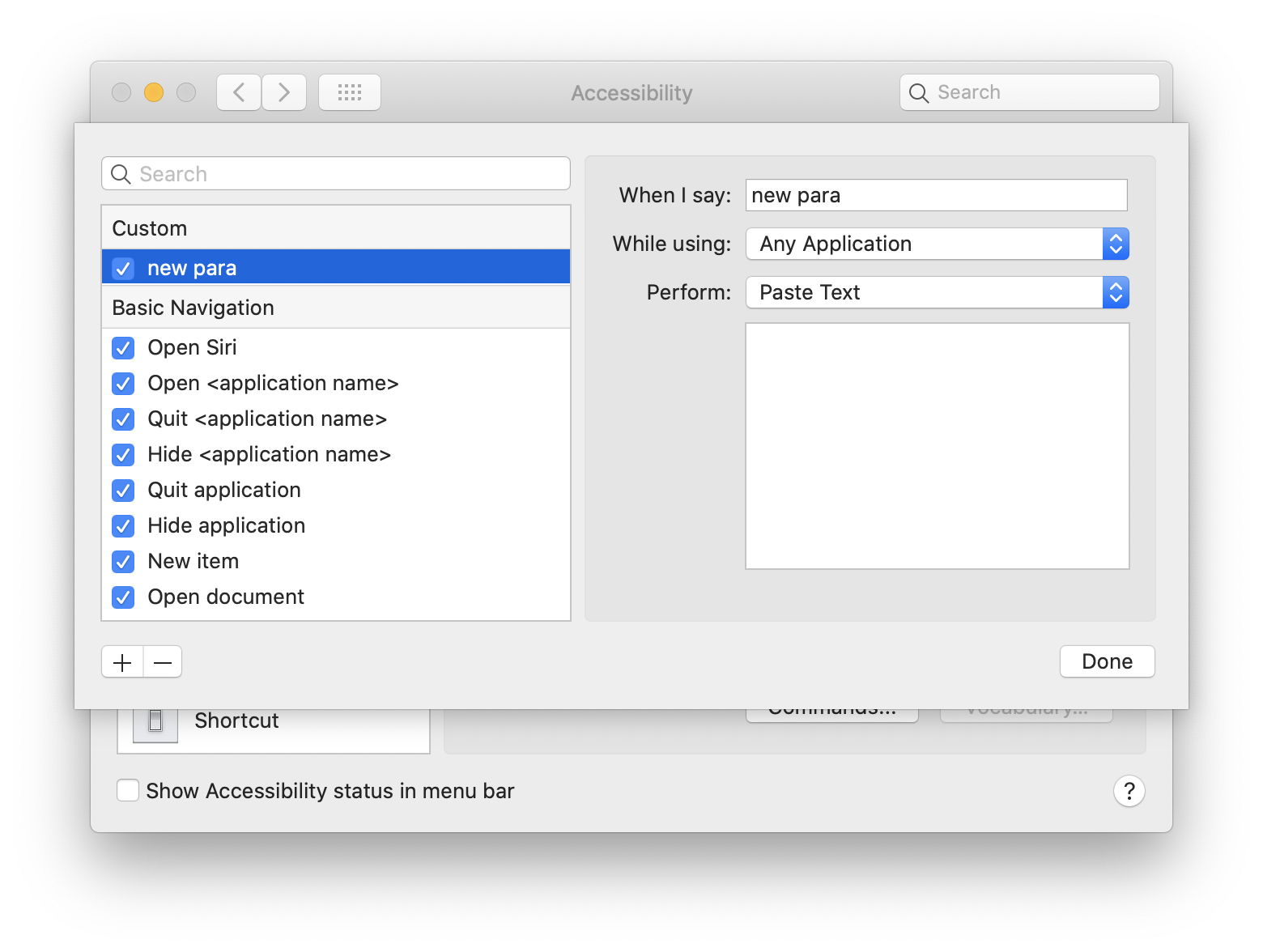
Create your own voice commands
- Open Voice Control preferences, such as by saying ”Open Voice Control preferences.”
- Click Commands or say ”Click Commands.” The complete list of all commands opens.
- To add a new command, click the add button (+) or say ”Click add.” Then configure these options to define the command:
- When I say: Enter the word or phrase that you want to be able to speak to perform the action.
- While using: Choose whether your Mac performs the action only when you're using a particular app.
- Perform: Choose the action to perform. You can open a Finder item, open a URL, paste text, paste data from the clipboard, press a keyboard shortcut, select a menu item, or run an Automator workflow.
- Use the checkboxes to turn commands on or off. You can also select a command to find out whether other phrases work with that command. For example, “Undo that” works with several phrases, including “Undo this” and “Scratch that.”
To quickly add a new command, you can say ”Make this speakable.” Voice Control will help you configure the new command based on the context. For example, if you speak this command while a menu item is selected, Voice Control helps you make a command for choosing that menu item.
Create your own dictation vocabulary
- Open Voice Control preferences, such as by saying ”Open Voice Control preferences.”
- Click Vocabulary, or say ”Click Vocabulary.”
- Click the add button (+) or say ”Click add.”
- Type a new word or phrase as you want it to be entered when spoken.
Learn more
- For the best performance when using Voice Control with a Mac notebook computer and an external display, keep your notebook lid open or use an external microphone.
- All audio processing for Voice Control happens on your device, so your personal data is always kept private.
- Use Voice Control on your iPhone or iPod touch.
- Learn more about accessibility features in Apple products.
1. Voice Control uses the Siri speech-recognition engine for U.S. English only. Other languages and dialects use the speech-recognition engine previously available with Enhanced Dictation.
2. If you're on a business or school network that uses a proxy server, Voice Control might not be able to download. Have your network administrator refer to the network ports used by Apple software products.
The best transcription software for Mac must be ideal for its users. The tool needs to have a simple interface, good options for manual transcription or automated transcription, and the ability to transcribe both audio files and video files. It’s also helpful to have a human transcription option.
Using human transcription can make transcripts more accurate when audio or video playback has problematic noise levels. If the speakers on those files have heavy accents or quiet speaking voices, a human ear more easily hears the distinctions. The transcription process is necessary for people in various fields like journalism, translation, law and more.
Best Human Transcription Option
Accuracy: Word-Error Rate
Word-Error Rate is a way to determine accuracy when transcribing using software for Mac OS. It has three items it takes into consideration. Those three items are substitution, insertion and deletion.
- Substitution: A word someone said during audio or video playback is replaced with another word. For instance, if someone says “choose,” the file shows it as “shoes.”
- Insertion: In this case, the transcription file adds an extra word the speaker didn’t say. It may mistake an “uh” for “a.”
- Deletion: This is the opposite of insertion. This might occur when someone uses an acronym like “IRS” and it chooses “I are s.”
The Formula for Determining Word-Error Rate
The formula for Word-Error rate is S (Substitution)+ I (Insertion)+ D (Deletion)/Number (Number of words in the transcription)
Rev’s manual transcription’s accuracy is consistently at 99%, guaranteed.
How It Works
There are a few steps for you to order human transcription services.
Best Dictation Software Mac
- First, upload your audio or video file or paste a public URL
- Then, one of over 50,000 transcriptionists available for our 24/7 service begins to work on your file
- You receive your editable transcript. Edits are easy with our tool with a simple interface, and you can share the document with anyone
Automated Transcription Software Option
Automated transcription software benefits people who need something quickly and have high-quality audio in their video or audio playback. Files from portable voice recorders and from audio players work well with this platform.
Free Speech To Text Software For Mac
Automatic transcription is usually generated by machines rather than people. This usually means quicker turnaround times and lower costs, but also lower accuracy rates
Accuracy
If the audio quality is good, automated transcription software is 80% accurate. Good audio has limited background noise, clear voices and speakers on the audio file have minimal accents. If there are any concerns about quality, human transcription is your best bet.
How it Works
- Review the transcript: automatic transcription is not as accurate as human transcription but is great for getting a quick result.
- Edit the transcript
- Share it and export it to another file or document.

Some free features of the service include the ability to synchronize text and audio, and edit the text in the Rev Transcript Editor. Highlighting the text while you edit allows you to isolate a quote and share either that portion or the whole document. You choose whether to let others edit your transcript (sharing features & collaborative transcript editing) or simply you can share a read-only version.
Cost
The cost for automatic transcription software comes in at $0.25 per minute.
How Our Options Offer the Best Transcription Software for Mac
When comparing transcript results from Rev’s automatic speech recognition (ASR) to transcription from other companies like Google, Amazon, Microsoft and more, we outdo the competition. Additionally, our human transcription service offers a 99% accuracy guarantee which is not available with many transcription services.
PC Mag Recognizes Rev as the Best Transcription Service
PC Mag rated Rev as the top choice for transcription services. The editors at PC Mag gave the top rating due to affordability, accuracy and ease of use. The magazine also mentioned quick turnaround times as a benefit to using our services.